

If you have seen KML in a text, comment, or social media conversation, you may wonder what these three letters mean.
In casual online communication, KML is commonly used as an expression of strong amusement.
It generally means “killing myself laughing,” a dramatic way of saying that something is extremely funny.
The phrase is usually not meant literally; it is internet slang used to emphasize laughter.
People often search for the meaning of KML because abbreviations can change depending on the conversation, platform, or community using them.
A message such as “KML 😂” can have a very different tone from a serious conversation, where the same letters might represent something unrelated.
Understanding the surrounding context is therefore important.
In this guide, we will explain the common slang meaning of KML, how it is used in texting and social media, how it differs from similar expressions, and how you can respond naturally when someone sends it.
Meaning & Definition
In texting and internet slang, KML usually means “killing myself laughing.” It is an exaggerated expression used when someone finds something particularly funny. Rather than simply saying “LOL,” a person may use KML to show that they are laughing very hard at something they have seen or read.
For example:
“You really thought that was a good idea? KML.”
Here, the sender is not describing actual self-harm. They are using an exaggerated expression to communicate amusement.
KML can appear after a joke, funny story, embarrassing moment, unexpected comment, meme, or humorous video. Its meaning is generally clear when the surrounding conversation is casual.
The expression is similar in function to phrases such as “I’m dying laughing” or “I can’t stop laughing.” Internet users frequently exaggerate emotional reactions for emphasis, and KML fits that style of communication.
The exact tone can vary. Someone might use it sincerely because something genuinely made them laugh, while another person might use it playfully or sarcastically. For instance:
- “Bro, your reaction was KML.”
- “I just watched that video, KML.”
- “You actually sent that to her? KML 😂”
The abbreviation is particularly common in informal conversations, where speed and brevity matter. Since slang evolves quickly, however, KML can occasionally have other meanings in specialized contexts. When there is uncertainty, the safest approach is to examine the surrounding words before deciding what the sender intended.
Usage in Different Contexts: Chat, Social Media, and Professional Fields
KML is primarily an informal internet abbreviation, so its most natural environment is casual communication. People may use it in private messages, group chats, comments, gaming conversations, and social media posts.
In casual chat
Friends may use KML when reacting to a joke or funny situation:
“You forgot your own birthday? KML.”
The abbreviation makes the response short while still communicating a strong emotional reaction.
On social media
KML may appear in comments beneath videos, memes, screenshots, or posts. Someone might write:
“The ending got me KML.”
In this situation, the person is emphasizing that the content was very funny.
In group conversations
KML can help show that someone is laughing at another person’s message. Because text does not carry facial expressions or vocal tone, abbreviations like KML can communicate emotion quickly.
In professional communication
KML is generally not appropriate for formal workplace writing unless the environment is exceptionally casual. It would usually be better to write something straightforward such as:
- “That was really funny.”
- “That made me laugh.”
- “I enjoyed that.”
A professional email, business report, academic paper, or formal message normally requires clearer and more conventional language.
The key distinction is context. Slang is designed for informal communication, while professional writing generally prioritizes clarity and a consistent tone.
Even if someone uses KML frequently with friends, that does not mean the abbreviation belongs in every type of conversation.
KML Meaning in Chat, WhatsApp, Instagram, and TikTok
The common slang interpretation of KML remains essentially the same across major social platforms: “killing myself laughing.” The surrounding content determines how strongly the expression should be interpreted.
KML in chat
In ordinary texting, KML can be a quick reaction to something funny.
Person A: “I walked into the wrong classroom again.”
Person B: “KML 😂”
The second person is simply expressing amusement.
KML on WhatsApp
WhatsApp conversations often contain abbreviations because people want to respond quickly. KML may appear alongside laughing emojis, GIFs, stickers, or other slang.
“That voice note was hilarious KML.”
KML on Instagram
On Instagram, KML can appear in comments, direct messages, or reactions to Reels and Stories. The abbreviation may communicate that a particular video, caption, or interaction is funny.
KML on TikTok
TikTok’s fast-moving culture encourages short reactions and slang. A viewer might comment “KML” under a funny video to indicate that the content made them laugh intensely.
However, context still matters. Not every three-letter abbreviation has one universal meaning. If KML appears in a caption involving a technical subject, organization, location, or specialized terminology, its meaning may be completely different.
The best way to interpret it is to look at the entire message rather than automatically assuming every use has the slang definition.
KML Meaning in Physics, Medical, and Aircraft Terminology
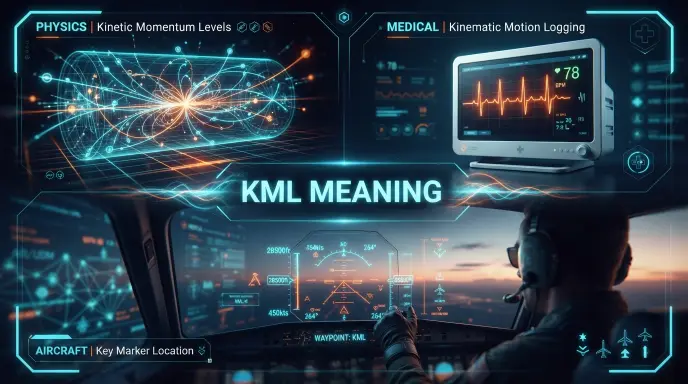
Although KML has a recognizable slang meaning online, abbreviations can also appear independently in technical or professional settings. This is one reason context is especially important.
Physics
KML is not generally a standard everyday physics abbreviation with one universally accepted meaning. A technical document may define its own abbreviations, symbols, or terminology.
Therefore, seeing KML in scientific material does not automatically mean “killing myself laughing.”
In technical writing, the surrounding material and the document’s abbreviation list should be checked before interpreting an unfamiliar acronym.
Medical terminology
Medical language contains thousands of abbreviations, and their meanings can vary between specialties and institutions.
KML is not a universally recognized general-purpose medical abbreviation that should automatically be interpreted according to internet slang.
If you encounter KML in a medical report, prescription-related document, or clinical discussion, you should rely on the document’s context or ask an appropriately qualified professional rather than applying the texting meaning.
Aircraft and aviation terminology
Aviation also uses many standardized abbreviations and codes. A three-letter combination can represent an airport, operational term, technical designation, or other aviation-related information depending on the system being used.
Therefore, KML in an aviation context should be interpreted according to the relevant aviation material rather than assumed to be internet slang.
The main lesson is simple: slang meaning depends heavily on context. In a casual text from a friend, KML is likely an expression of laughter.
In a technical document, it may represent something completely unrelated.
Common Misconceptions About KML
One common misconception is that KML always has the same meaning everywhere. Internet abbreviations can have multiple interpretations, and specialized fields may use identical letter combinations for different purposes.
Another misconception is that “killing myself laughing” should always be interpreted literally. In casual slang, the phrase is normally hyperbolic. The sender is exaggerating their reaction to communicate that something is extremely funny.
A third misconception is that KML is identical to every other laughter abbreviation. While KML, LOL, LMAO, and similar expressions can all communicate amusement, their tone and intensity can differ.
For example, someone might use:
- LOL for ordinary laughter.
- LMAO for stronger amusement.
- KML for exaggerated laughter.
- 😂 as a visual expression of laughing.
These are not strict rules. People often use slang differently depending on their personality, age group, online community, and conversational style.
It is also possible to misread KML when only a single message is available. If someone writes “KML” after a joke, the interpretation is straightforward.
If the abbreviation appears without any surrounding information, asking for clarification may be more appropriate.
Finally, slang changes over time. Expressions that are popular in one online community may be uncommon in another. Therefore, understanding the conversation as a whole is usually more useful than memorizing isolated abbreviations.
Similar Terms and Alternatives
Several expressions can communicate a reaction similar to KML. However, each may carry a slightly different level of intensity or style.
LOL
LOL means “laughing out loud.” It is one of the most widely recognized ways to show amusement in digital communication.
LMAO
LMAO is a stronger and more informal expression meaning “laughing my ass off.” It is commonly used when someone finds something extremely funny.
LMFAO
This is an even more emphatic version of the same general idea. It is highly informal and can sound more exaggerated.
ROFL
ROFL means “rolling on the floor laughing.” Like KML, it presents laughter in an exaggerated way.
😂
The laughing-with-tears emoji can serve the same basic purpose without using an abbreviation.
“I’m dying”
Someone may say “I’m dying” or “I’m dead” in casual conversation to mean that something is extremely funny. These expressions are also generally figurative.
The best choice depends on your relationship with the other person and the tone of the conversation. A simple “LOL” may work in a casual chat, while a professional message should usually avoid slang abbreviations altogether.
How to Respond to KML
If someone sends you KML after reading your message, watching your video, or seeing something you shared, you can usually respond casually. You do not need to provide a complicated answer.
If you want to continue the joke, you might say:
“😂 I knew you’d find that funny.”
Or:
“I was waiting for your reaction!”
If the person sends KML after you tell an embarrassing story, you could respond playfully:
“Glad my embarrassment entertained you.”
If you are unsure what they mean, you can simply ask:
“What do you mean by KML?”
That is especially useful when the conversation is not obviously about something funny.
Your response should match the relationship and situation. With a close friend, humor and emojis may feel natural. With someone you have recently met, a simple response can be safer until you understand their communication style.
Remember that online tone can be difficult to interpret. KML usually signals amusement, but whether it is genuine, sarcastic, teasing, or exaggerated depends on the surrounding conversation.
Differences Between KML and Similar Words
KML stands apart from similar slang through its tone, intensity, and personal style, even though it serves a similar purpose.
KML vs. LOL: LOL is a broader and more widely recognized expression of laughter. By comparison, KML may convey a stronger or more dramatic reaction to something funny.
KML vs. LMAO: While both expressions communicate strong amusement, they come from different phrases. LMAO can also sound more explicit because of the wording represented by the acronym.
ROFL creates the image of someone physically “rolling on the floor,” while KML uses an exaggerated expression about laughing.
KML vs. 😂: The emoji communicates laughter visually, whereas KML communicates it through text.
KML vs. “dead”: Saying “I’m dead” after a joke is another internet expression for extreme amusement. It does not necessarily mean the same literal thing as the words suggest.
There are no universal rules that determine which expression represents exactly how much someone is laughing. Online slang is flexible. Two people can see the same joke and use completely different reactions.
For that reason, you should treat these distinctions as general patterns rather than strict definitions. The conversation, relationship, and communication style often provide more information than the abbreviation itself.
Relevance in Online Conversations and Dating Apps
KML can be particularly useful in fast-moving online conversations because it provides an immediate emotional reaction without requiring a full sentence.
On dating apps, social platforms, and messaging services, people often use short slang expressions to keep conversations relaxed and playful.
For example, if someone sends a funny story on a dating app, replying with:
“KML 😂”
can communicate that you genuinely enjoyed the message.
However, KML does not automatically indicate romantic interest. Someone using the abbreviation may simply be laughing at something you said.
It should not be treated as definite evidence of attraction, flirting, or emotional interest.
The surrounding conversation matters more. If the person is asking questions, continuing the conversation, sharing personal stories, or using playful language, those details provide broader context. KML itself simply indicates amusement in its common slang usage.
It can also help reduce the risk of sounding overly serious. Digital conversations lack many of the cues present in face-to-face communication, so short reactions can help establish a friendly tone.
Still, slang preferences vary considerably. Some people use abbreviations constantly, while others rarely use them. If someone does not understand KML, that does not necessarily indicate anything about their personality or interest.
It may simply mean they are unfamiliar with that particular piece of internet slang.
FAQs :
1. What does KML mean in slang?
KML usually means “Killing Myself Laughing.” It is used online to show that something is extremely funny.
2. What does KML mean in texting?
In texting, KML is commonly used to express strong laughter, similar to “LOL” or “LMAO.”
3. Is KML a bad word?
No. KML is generally not considered a bad word. It is casual internet slang used to react to something funny.
4. What does KML mean on Snapchat?
On Snapchat, KML usually means “Killing Myself Laughing.” Someone may send it when they find a message, photo, or story hilarious.
5. What does KML mean on TikTok?
On TikTok, KML is often used in comments or messages to show that a video or situation is very funny.
6. Is KML the same as LOL?
They have a similar purpose, but KML generally expresses stronger laughter than the more common “LOL.”
7. How do you respond to KML in a text?
You can respond naturally with “LOL,” “LMAO,” “I know 😂,” or another funny reaction, depending on the conversation.
8. Can KML have other meanings?
Yes. KML can have different meanings depending on context. In casual texting and social media, however, “Killing Myself Laughing” is a common slang interpretation.
9. Is KML still used in texting?
KML can still appear in online conversations, although slang preferences vary by age group, platform, and region.
10. What is the difference between KML and LMAO?
Both indicate laughter. KML means “Killing Myself Laughing,” while LMAO means “Laughing My Ass Off.” KML is generally used as a humorous reaction rather than a literal statement.
Conclusion
KML is commonly used in texting and online slang to mean “killing myself laughing.” It is an exaggerated, informal way of saying that something is extremely funny.
You may encounter it in private messages, group chats, WhatsApp conversations, Instagram comments, TikTok discussions, and other casual online spaces.
Although the slang interpretation is common, context remains important.
The same letters can represent something different in technical, professional, scientific, medical, or aviation-related material.
For that reason, you should not automatically apply the internet meaning whenever you see KML.
KML is broadly similar to expressions such as LOL, LMAO, ROFL, “I’m dying,” and the 😂 emoji, although each can have a slightly different tone.
In dating or casual conversations, it generally communicates amusement rather than automatically signaling romantic interest.
When someone sends KML, a simple humorous response, laughing emoji, or continuation of the joke is usually enough.
The surrounding conversation will ultimately tell you what the sender intended.

Hi, I’m Jackson Lee, the creator of EnglishIDM. I’m passionate about English words, idioms, phrases, and everyday expressions. I created EnglishIDM to make confusing English meanings simple, clear, and easy to understand. My goal is to help readers build stronger vocabulary and communicate with confidence—one word and phrase at a time.