

The phrase body count meaning slang can be confusing because “body count” has different meanings depending on the situation.
In modern texting, social media, and dating conversations, it most commonly refers to the number of people someone has had sexual relationships or encounters with.
The phrase can be used casually, jokingly, or as a serious question about someone’s dating history. However, the expression is not always about relationships.
In news reports, gaming, military discussions, and other contexts, “body count” can refer to the number of people who have died in an event.
Because the meaning changes with context, understanding the conversation around the phrase is important.
People often search for this slang because they see it on TikTok, Instagram, WhatsApp, dating apps, or in casual conversations and want to know whether it is referring to relationships, deaths, or something else.
This guide explains the common meanings, uses, misconceptions, and appropriate ways to respond.
Meaning & Definition
In contemporary slang, body count usually means the number of people someone has had sex with. For example, if someone asks, “What’s your body count?” they are generally asking about the number of previous sexual partners that person has had.
Simple example
- Person A: “Can I ask your body count?”
- Person B: “I’d rather keep that private.”
Here, “body count” is being used as informal slang for a person’s number of sexual partners.
The expression can also be used in a broader dating context. Someone might ask about a person’s romantic or sexual history without necessarily intending to judge them. However, because the phrase can feel personal or intrusive, the person being asked does not have to answer.
There is another established meaning. In discussions involving wars, disasters, violent incidents, or fictional battles, body count can refer to the number of people killed. For instance, “The battle had a high body count” refers to fatalities rather than sexual partners.
The surrounding words usually make the intended meaning clear. If the conversation involves dating, relationships, hookups, or attraction, the slang meaning is likely intended. If the discussion involves an accident, conflict, crime, or fictional combat, the term may refer to deaths.
Therefore, body count is a context-dependent expression rather than a term with only one definition.
Usage in Different Contexts: Chat, Social Media, and Professional Fields

The meaning of “body count” changes significantly according to the setting.
In casual chat
Among friends, the phrase is often used as slang for someone’s number of sexual partners. It may appear in conversations about dating or relationships.
Example:
“He asked me what my body count was.”
The speaker is most likely talking about previous sexual partners.
On social media
Platforms such as TikTok, Instagram, X, Reddit, and similar sites frequently use “body count” in dating discussions, memes, debates, and relationship-related content. Some posts use it seriously, while others use it humorously or provocatively to attract attention.
You may also see phrases such as:
- “Does body count matter?”
- “High body count”
- “Low body count”
- “What is an acceptable body count?”
These phrases generally concern someone’s sexual history.
In professional or formal contexts
The slang meaning is generally inappropriate for formal workplace communication unless the subject itself is being discussed in a relevant professional context. A workplace conversation about someone’s private sexual history would normally be considered personal rather than professional.
In journalism, emergency reporting, military history, or crime-related discussions, however, “body count” can have a different meaning: the number of fatalities.
For example:
“Officials reported the body count after the disaster.”
In that context, it refers to deaths.
The key is to consider who is speaking, what they are discussing, and the surrounding vocabulary before deciding what the phrase means.
Meaning in Chat, WhatsApp, Instagram, and TikTok

On messaging and social platforms, body count is most often associated with dating and sexual relationships.
On WhatsApp, someone might privately ask:
“What’s your body count?”
In this situation, the person is usually asking about the number of previous sexual partners.
On Instagram, the phrase can appear in comments, direct messages, Stories, captions, or relationship discussions. A post might ask followers whether someone’s dating history matters to them.
On TikTok, “body count” is frequently used in relationship discussions, jokes, interviews, street-question videos, and debates. Because TikTok content often relies on short phrases and trends, the expression may appear without much explanation.
The phrase can also be shortened in informal conversation. Someone might simply say:
“What’s your count?”
Depending on the conversation, that could mean the same thing, although “count” alone is much more ambiguous.
Tone matters too. A question about body count may be:
- Genuine curiosity
- Flirtatious
- Judgmental
- Humorous
- Part of a dating conversation
- Asked for social-media content
Not every use has the same intention.
If someone asks the question and you are uncomfortable answering, you can simply say, “I’d rather not discuss that.” You do not need to provide personal information just because someone asks.
Body Count Meaning in Physics, Medical, and Aircraft Terminology

The phrase has different meanings outside modern dating slang, so context is especially important.
Physics
“Body count” is not a standard general physics term for the number of sexual partners. In physics, the word “body” can refer to a physical object, such as a celestial body or another physical system, but “body count” is not normally used as a basic technical measurement.
If you encounter the phrase in a physics-related discussion, examine the specific field or source to determine what the writer means.
Medical context
In medical and healthcare settings, “body count” is not generally a standard clinical term for sexual partners. Healthcare professionals normally use clearer language such as number of sexual partners or sexual history when discussing sexual health.
In discussions of disasters or mass-casualty events, however, informal reporting may use “body count” to describe fatalities. Formal medical communication generally uses more precise terminology, such as number of deaths, fatalities, or casualties, depending on the situation.
Aircraft and aviation
“Body count” is also not a standard aviation measurement. In aviation accidents, informal media discussions may use the expression to refer to people who died in a crash, but professional aviation reporting generally uses terms such as fatalities, passengers killed, or accident deaths.
This distinction is useful because seeing “body count” in an aviation or accident-related article does not automatically mean the dating slang definition.
Common Misconceptions About Body Count
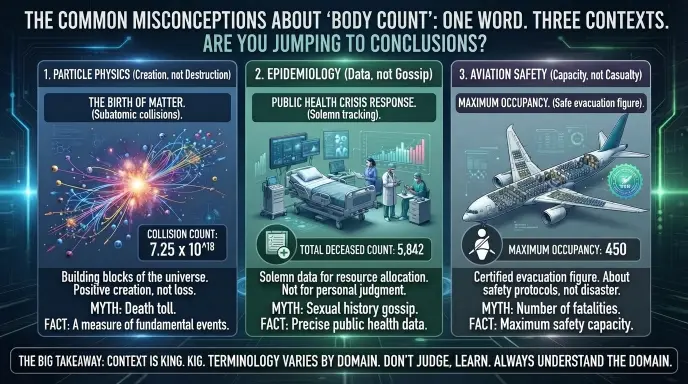
One common misconception is that “body count” always means the number of sexual partners. That is not true. The expression has an older and broader meaning connected with fatalities, particularly in discussions of war, violence, disasters, or fictional combat.
Another misconception is that the term automatically tells you something about a person’s character. It does not. A number alone cannot provide a complete picture of someone’s relationships, values, experiences, or current behavior.
People also sometimes assume that “body count” and “number of relationships” mean exactly the same thing. They do not necessarily mean the same thing. A person may have had several relationships without having had sexual activity in each relationship, while sexual encounters do not always occur within formal relationships.
Another misunderstanding concerns the phrase “high body count” or “low body count.” These are subjective expressions. There is no universal numerical definition that makes a body count “high” or “low.”
Finally, people sometimes believe they are required to answer when someone asks their body count. They are not. Sexual history is personal information, and someone can choose whether or not to discuss it.
The most accurate approach is to consider the context rather than assuming a meaning from the phrase alone.
Similar Terms & Alternatives
Several expressions can overlap with “body count,” but they are not always identical.
Number of sexual partners
This is the clearest and most neutral alternative when discussing sexual history. It removes much of the slang and potential ambiguity.
Sexual history
This is broader than body count. It can include previous partners, sexual experiences, testing history, protection practices, and other relevant information.
Dating history
Dating history focuses more generally on previous romantic relationships and experiences. It does not necessarily indicate how many sexual partners someone has had.
Past partners
This can refer to romantic or sexual partners depending on context. It is less slang-heavy than “body count.”
Body count vs. partner count
“Partner count” may sometimes be used to mean the same thing as body count in online conversations, but it is usually easier to understand without additional context.
The important distinction is that body count is informal and potentially sensitive, while phrases such as “number of sexual partners” are clearer and more neutral.
How to Respond When Someone Asks Your Body Count

How you respond depends on your comfort level and your relationship with the person asking.
If you are comfortable answering, you can give a straightforward response:
“I’ve had two previous partners.”
If you do not want to share personal information, you can politely set a boundary:
“I keep that part of my personal life private.”
For a casual conversation, a lighter response could be:
“That’s a pretty personal question.”
If you want to understand why they are asking, you could say:
“Why do you want to know?”
This can help reveal whether the question is coming from genuine curiosity, dating compatibility concerns, or simple entertainment.
If the question feels disrespectful or judgmental, you can end the conversation rather than defending your personal history.
There is also an important distinction between answering a question and feeling pressured to justify yourself. You can decline to provide a number without explaining why.
In a serious relationship, discussions about sexual health may be more useful than focusing exclusively on a numerical count. Topics such as STI testing, contraception, boundaries, exclusivity, and expectations can provide more meaningful information about compatibility and safety.
Differences From Similar Words and Phrases
“Body count” can easily be confused with several related expressions.
| Term | Common meaning |
|---|---|
| Body count | Usually number of sexual partners in modern slang; can also mean fatalities |
| Partner count | Number of sexual or romantic partners, depending on context |
| Dating history | Previous romantic dating experiences |
| Sexual history | Broader information about previous sexual experiences |
| Body count in warfare | Number of people killed |
| Casual partner | Someone involved in a non-serious romantic or sexual relationship |
| Exes | Former romantic partners |
The biggest difference is context and scope.
For example, if someone says, “She has three exes,” they are referring to former romantic relationships. If someone says, “Her body count is three,” they are usually referring to sexual partners. Those numbers could be the same, but they do not have to be.
Similarly, “body count” in a news report about a disaster has nothing to do with dating. In that context, it refers to fatalities.
When interpreting slang, looking at the complete sentence is usually more reliable than focusing on one word.
Relevance in Online Conversations and Dating Apps

The expression has become particularly common in online dating discussions because dating apps make conversations about relationships and personal preferences more direct.
Someone may ask about body count early in a conversation, while another person may consider the question too personal for an initial interaction. Different people have different boundaries around discussing sexual history.
On dating apps, the phrase can also appear in profiles, comments, memes, or conversation starters. Its meaning is usually related to previous sexual partners when surrounded by words such as dating, hookups, relationships, exes, virginity, or sexual experience.
However, online communication can make tone difficult to interpret. A question that sounds playful to one person may feel judgmental to another. Text messages also lack facial expressions and vocal tone, so misunderstandings are common.
If you encounter the phrase online and are unsure what someone means, a simple clarification can help:
“Do you mean previous sexual partners?”
That avoids making assumptions.
It is also useful to remember that a person’s past does not automatically explain their present relationship choices. When people are getting to know each other, conversations about trust, boundaries, expectations, and sexual health may be more informative than a single number.
FAQs :
What does “body count” mean in slang?
In modern slang, body count usually refers to the number of people someone has had sexual relationships or encounters with. The exact meaning can vary depending on the conversation and context.
Does body count always mean sexual partners?
No. In some contexts, body count can refer to the number of people who have died, especially in discussions about wars, disasters, crime, or fictional stories. Online slang, however, often uses it to mean sexual partners.
What does it mean when someone asks, “What’s your body count?”
They are usually asking how many sexual partners you have had. Because this is a personal question, some people may consider it intrusive or inappropriate.
Is “body count” a rude term?
It can sound blunt or judgmental depending on how it is used. In casual online conversations, it is common slang, but more respectful wording may be “number of sexual partners” or “sexual history.”
What does body count mean on TikTok or social media?
On platforms such as TikTok, Instagram, and Snapchat, body count commonly means the number of sexual partners a person has had. It may appear in jokes, dating discussions, memes, or relationship-related conversations.
Can body count have a different meaning?
Yes. Context matters. For example, “The movie had a high body count” could refer to the number of deaths in a movie, while “What’s your body count?” in a dating conversation usually refers to sexual partners.
Is body count the same as number of relationships?
Not necessarily. A person may have had several sexual partners without being in a formal relationship with each person. Therefore, body count and relationship count are not automatically the same.
How should I respond if someone asks my body count?
You do not have to answer. You can simply say, “I’d rather keep that private,” or change the subject. If you are comfortable discussing it, you can answer honestly without feeling pressured.
Does body count determine someone’s character?
No. A person’s sexual history by itself does not provide a complete measure of their personality, values, or character. People have different experiences and boundaries.
Why is body count discussed so much online?
The phrase has become common in social-media conversations about dating, relationships, attraction, and personal experiences. It is also frequently used in memes and debates, which has increased its visibility as internet slang.
Conclusion
The body count meaning slang most commonly refers to the number of people someone has had sexual relations with.
It is an informal expression frequently seen in texting, social media, dating discussions, and online conversations.
However, the phrase has another established meaning: in discussions involving war, crime, disasters, or accidents, it can refer to the number of people who died.
Context is therefore essential when interpreting the phrase.
On WhatsApp, Instagram, TikTok, or a dating app, it will usually have the relationship-related meaning, while news or accident-related discussions may use it to describe fatalities.
Because body count can involve private information, people should also feel free to establish their own boundaries when asked about it.
Understanding the phrase is less about memorizing one definition and more about recognizing how the surrounding conversation determines its meaning.

Hi, I’m Jackson Lee, the creator of EnglishIDM. I’m passionate about English words, idioms, phrases, and everyday expressions. I created EnglishIDM to make confusing English meanings simple, clear, and easy to understand. My goal is to help readers build stronger vocabulary and communicate with confidence—one word and phrase at a time.