
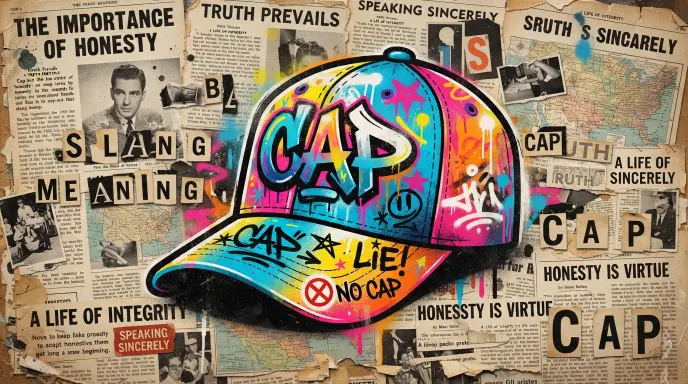
If you have seen someone write “That’s cap,” “No cap,” or simply “cap” in a message, you may wonder what the word actually means. In modern internet slang, cap usually means a lie, exaggeration, or something that is not true.
When someone says “You’re capping,” they are accusing another person of exaggerating or being dishonest. On the other hand, “no cap” means “I’m telling the truth” or “I’m being completely serious.”
The expression appears frequently in text messages, WhatsApp conversations, Instagram comments, TikTok videos, gaming communities, and dating apps. Its popularity comes from its short, expressive nature: one word can communicate that someone doubts what another person has said.
However, “cap” does not always have its slang meaning. Depending on the situation, it can refer to a physical hat, a limit, a technical abbreviation, or a professional term. Understanding the surrounding context is therefore essential.
Meaning & Definition of “Cap” in Slang

In contemporary slang, cap means a lie, false statement, exaggeration, or something that a speaker considers untrue.
For example:
- “He said he owns five cars. That’s cap.”
- “I’m not capping—I actually met her.”
- “No cap, this is the best restaurant I’ve tried.”
- “Stop capping and tell me what really happened.”
The word can function as both a noun and a verb. As a noun, someone can describe a statement as “cap.” As a verb, “capping” means lying or exaggerating.
The exact meaning depends on the sentence. “That’s cap” generally means “That’s not true,” while “no cap” means “No lie” or “Honestly.” The phrase can be serious, playful, skeptical, or teasing.
The slang became especially widespread through hip-hop and online youth culture before becoming common across social-media platforms. Today, people may use it even when they are not deeply familiar with its original cultural context.
What Does “No Cap” Mean?
“No cap” is one of the most recognizable expressions. It means “I’m telling the truth,” “seriously,” or “without exaggeration.”
For example:
“No cap, that was the funniest movie I’ve ever watched.”
The speaker is emphasizing that they genuinely mean what they are saying.
What Does “Cap” Mean by Itself?

When somebody replies simply with “cap”, they are usually saying:
“I don’t believe you.”
It can be similar to saying:
- “That’s a lie.”
- “You’re exaggerating.”
- “I don’t buy it.”
- “Seriously?”
- “You’re making that up.”
The tone can range from playful disbelief to genuine accusation.
Usage in Different Contexts
The slang meaning of cap is particularly common in informal communication. Its popularity is partly due to its convenience: instead of writing “I don’t believe that,” someone can simply type “cap.”
In Text Messages
In ordinary texting, “cap” is often used when friends challenge each other.
Person A: “I finished the entire assignment in ten minutes.”
Person B: “Cap 😂”
Here, the second person probably does not literally accuse their friend of serious dishonesty. They are expressing disbelief in a humorous way.
On Social Media
On Instagram, TikTok, X, YouTube, and similar platforms, users may comment “cap” when they think a creator has exaggerated a story, claim, achievement, or opinion.
“No cap” can also be used to emphasize sincerity:
“No cap, this is one of the best songs I’ve heard this year.”
Because social media often contains exaggerated claims and attention-grabbing statements, the slang fits naturally into online discussions.
In Casual Conversation
The expression has also moved beyond the internet. Friends may say “You’re capping” during face-to-face conversations.
For example:
“You said you weren’t hungry, but you just ordered another pizza. You’re capping.”
Here, “capping” means pretending or saying something that does not match reality.
In Professional Fields
The slang meaning is generally not appropriate for formal professional communication. In a workplace email, academic paper, medical report, engineering document, or business presentation, “cap” should not automatically be interpreted as “lie.”
In professional contexts, the word may have a completely different meaning. For example, “cap” can refer to a limit, a capitalization abbreviation, a technical component, or an acronym.
The surrounding subject matter therefore matters more than the word itself.
Meaning in Chat, Whats App, Instagram, and Ticktock

The meaning of cap remains essentially the same across most major social and messaging platforms, although the way people use it can vary.
Cap Meaning in Chat
In chat, cap usually signals disbelief.
Someone might respond:
“Cap.”
This means they believe the previous statement is false or exaggerated.
Another person might write:
“You’re capping.”
That means:
“You’re lying or exaggerating.”
Cap Meaning on WhatsApp
WhatsApp conversations are usually informal, so cap can be used exactly as it is in ordinary texting.
For example:
“I didn’t eat your snacks.”
“Cap 😂”
The response suggests the sender believes the other person did eat them.
Cap Meaning on Instagram
On Instagram, cap often appears in comments and direct messages. A person might comment “No cap” to agree strongly with a statement:
“No cap, your photography has improved so much.”
Alternatively, “That’s cap” can challenge a claim made in a post or comment.
Cap Meaning on TikTok
TikTok has helped popularize and spread internet slang, including “cap” and “no cap.” Users may put the word into captions, comments, spoken dialogue, or humorous videos.
For instance:
“No cap, I thought this was going to fail.”
The expression gives the statement an informal and conversational tone.
It is important to remember that slang changes quickly. A phrase that is extremely popular on one platform may become less common later, while its meaning may remain understandable to a broader audience.
“Cap” in Physics, Medical, and Aircraft Terminology
The slang meaning should not be confused with technical meanings. In scientific, medical, military, and aviation contexts, CAP can represent completely different concepts.
CAP in Physics and Technical Contexts
In physics and engineering, “cap” may appear as an informal abbreviation for terms involving capacitance, capacitors, or capacity, depending on the specific field and notation being used. However, there is no universal physics definition in which every occurrence of “cap” means one particular thing.
A technical document may also use “cap” to mean a limit or maximum allowable value. For example, a system could have a capacity cap or operating limit.
Therefore, technical readers should rely on the terminology defined within the particular subject or document rather than interpreting “cap” as internet slang.
CAP in Medicine
In medicine, CAP commonly stands for community-acquired pneumonia. This refers to pneumonia acquired outside a hospital or certain healthcare settings.
For example, a medical professional might write “CAP” in clinical documentation when discussing community-acquired pneumonia.
This is completely unrelated to the slang meaning of “cap.”
CAP in Aircraft and Aviation
In aviation and military terminology, CAP can stand for Combat Air Patrol. It describes an aerial patrol performed to protect an area, force, aircraft, or other assets from hostile aircraft.
In other aviation-related contexts, abbreviations can have different meanings depending on the organization, aircraft system, or document.
This illustrates an important point: capitalization and context can completely change the meaning of an abbreviation.
If someone writes “That’s cap” in a TikTok comment, they are probably talking about slang. If a pilot, engineer, or military professional uses “CAP” in a technical discussion, it may mean something entirely different.
Common Misconceptions About “Cap”

One common misconception is that “cap” always means hat. In standard English, a cap can certainly be a type of headwear. But in internet slang, “cap” usually refers to dishonesty or exaggeration.
Another misconception is that “cap” always means a serious lie. In casual conversations, it can be playful. A friend might say “cap” simply because they find another person’s story unbelievable.
Some people also assume that “no cap” means “no limit.” In slang, that is generally not the intended meaning. “No cap” usually means “no lie” or “I’m being truthful.”
A further misunderstanding occurs when people interpret “capping” as simply “talking.” In slang, “capping” specifically suggests that someone is not being completely truthful, although the seriousness depends on the context.
Finally, not every use of the word “cap” online is slang. Someone discussing clothing, a bottle, a maximum limit, a technical subject, or an abbreviation may be using the ordinary or professional meaning.
Similar Terms & Alternatives
Several expressions can communicate an idea similar to “cap.”
“Lying”
This is the most direct standard-English equivalent. It is stronger and more explicit than slang.
“You’re lying.”
“BS”
This informal expression suggests that someone is talking nonsense or making an unbelievable claim. It can be more aggressive depending on the context.
“Fake”
“Fake” can describe something that is false, fabricated, or not genuine.
“Exaggerating”
This is useful when a person may not be deliberately lying but is making something sound more extreme than it really is.
“No lie”
“No lie” is one of the closest alternatives to “no cap.”
“No lie, that was incredible.”
“Seriously”
“Seriously” can perform a similar function when someone wants to emphasize sincerity.
“Seriously, I didn’t know about it.”
“For real”
“For real” is another common informal expression used to emphasize truthfulness or agreement.
The best alternative depends on the tone. “Cap” is highly casual, while “I’m telling the truth” is more neutral and suitable for formal situations.
How to Respond to “Cap”
Your response should depend on whether the person is joking, questioning you, or genuinely accusing you of lying.
If they say “cap” and you are telling the truth, you could respond:
- “No cap, I’m serious.”
- “I swear, it actually happened.”
- “I’m being completely honest.”
- “For real.”
- “Believe me, I’m not making this up.”
If they are joking, you can respond playfully:
- “I wish I was capping 😂”
- “Believe it or not, it’s true.”
- “You can check for yourself.”
- “I knew you wouldn’t believe me.”
If you realize you exaggerated, you can simply admit it:
“Okay, maybe I exaggerated a little.”
When someone says “no cap,” you do not necessarily need to challenge them. It usually functions as an emphasis that they believe their statement is true.
Differences Between “Cap,” “Lie,” “No Cap,” and “Capping”
Although these terms are related, they are not exactly interchangeable in every situation.
| Expression | Typical meaning |
|---|---|
| Cap | A lie, exaggeration, or unbelievable claim |
| Capping | Lying or exaggerating |
| No cap | Honestly; no lie; seriously |
| Lie | A false statement, usually more direct and serious |
| Exaggerating | Making something seem greater or more extreme |
| For real | Seriously; genuinely |
| No lie | Honestly; truthfully |
The biggest difference is tone.
“Lie” is standard English and can sound serious. “Cap” is informal internet and conversational slang. “No cap” emphasizes sincerity, while “capping” describes the behavior of exaggerating or lying.
For example:
“You’re lying.”
is direct and potentially confrontational.
“You’re capping.”
usually sounds more casual and may even be humorous.
Similarly:
“I’m telling the truth.”
is neutral, whereas:
“No cap.”
is informal and slang-heavy.
Relevance in Online Conversations & Dating Apps

Cap has particular relevance in online communication because people often make claims about themselves, their experiences, appearance, achievements, relationships, or lifestyle.
On dating apps, someone might use “cap” when they suspect that a match is exaggerating.
For example:
“You said you’re a professional chef, but you can’t even boil pasta. Cap 😂”
In this case, the expression is playful.
A person might also say:
“No cap, your profile is really interesting.”
Here, the speaker is emphasizing that their compliment is genuine.
However, context and tone are important. Calling someone a liar can easily create conflict, especially when people do not know each other well. A short message such as “cap” may sound funny between close friends but rude or dismissive when sent to a stranger.
In dating conversations, it is therefore often better to clarify what you mean rather than relying entirely on slang. For example, “Really? I didn’t know that” can sound less confrontational than “cap.”
The expression is especially useful online because it is short, recognizable, and emotionally expressive. It can communicate skepticism without requiring a long explanation.
Why “Cap” Became So Popular
Internet slang tends to spread because it makes communication faster and more expressive. “Cap” is particularly effective because it turns a complicated idea—“I think you’re lying or exaggerating”—into one short word.
The expression also works well with humor, emojis, memes, videos, and informal conversations. “No cap” provides the opposite function by emphasizing sincerity.
Social media has helped these expressions move between different communities and age groups. Words that once belonged primarily to particular cultural or musical communities can eventually become familiar to a much wider online audience.
Even so, slang is not static. Meanings can shift, and different communities may use the same word differently. Understanding the conversation around the word is always more reliable than memorizing a single definition.
FAQs:
1. What Does Cap Mean In Slang?
In slang, cap usually means a lie, false statement, or something that is not true. If someone says “That’s cap,” they usually mean “That’s not true” or “You’re lying.”
2. What Does No Cap Mean In Texting?
No cap means “I’m being honest” or “I’m not lying.” People often use it to emphasize that what they are saying is genuine or truthful.
3. What Does You’re Capping Mean?
You’re capping means “You’re lying” or “You’re not telling the truth.” It is commonly used in casual conversations, texts, and social media.
4. Is Cap A Bad Word?
No, cap is not usually considered a swear word. It is casual internet slang, so it is generally appropriate for informal conversations but may not fit professional or formal writing.
5. What Does Stop Capping Mean?
Stop capping means “Stop lying” or “Stop exaggerating.” The exact meaning depends on the conversation and how seriously the speaker is using it.
6. What Does That’s Cap Mean?
That’s cap means the speaker believes something is untrue, exaggerated, or made up. For example, if someone makes an unbelievable claim, another person might reply, “That’s cap.”
7. What Is The Difference Between Cap And No Cap?
Cap refers to a lie or something untrue, while no cap signals honesty. For example, “You’re capping” suggests someone is lying, whereas “No cap, I really saw it” emphasizes that the speaker is being truthful.
8. How Is Cap Used On Social Media?
On platforms such as TikTok, Instagram, Snapchat, and X, cap is commonly used to call out statements that seem false or exaggerated. Its meaning remains largely the same across casual online conversations.
9. Can Cap Mean Something Other Than Lying?
Yes. Cap can have other meanings depending on context. In everyday English, it can refer to a type of hat or a limit, while in slang it commonly relates to lying or exaggeration.
10. How Should I Respond When Someone Says Cap?
Your response depends on the situation. If you are telling the truth, you could provide evidence or simply say that you are being serious. If you were joking or exaggerating, you can clarify what you meant.
Conclusion
The slang “cap” generally means a lie, exaggeration, or statement that someone does not believe. When someone says “That’s cap,” they are expressing disbelief. “You’re capping” means that someone is perceived as lying or exaggerating, while “no cap” means “honestly,” “seriously,” or “without lying.”
The expression is especially common in text messages, Whats App Instagram, Ticktock, gaming communities, and other informal online conversations. It can be humorous or serious depending on the relationship between the speakers.
At the same time, “cap” has many non-slang meanings. It can refer to headwear, a limit, or a technical abbreviation. In medicine, CAP can mean community-acquired pneumonia, while in aviation and military contexts it can mean Combat Air Patrol.
The key to understanding “cap” is therefore context. In casual internet conversation, it usually concerns truthfulness; in professional or technical communication, it may mean something entirely different.

Hi, I’m Jackson Lee, the creator of EnglishIDM. I’m passionate about English words, idioms, phrases, and everyday expressions. I created EnglishIDM to make confusing English meanings simple, clear, and easy to understand. My goal is to help readers build stronger vocabulary and communicate with confidence—one word and phrase at a time.